§01 — What the site demands
Mechanical, thermal and atmospheric conditions in extractive and process industries
These sites combine the hardest mechanical duty of any cable application with the strictest fire-performance requirements. Cable is dragged across rock, run over by vehicles, reeled onto mobile machinery, hung in shafts, buried in tailings and routed through tunnels and enclosed modules where egress is long and ventilation limited. The loads are large and remote — face machinery, pumps, crushers, conveyors — fed from substations that move as the face advances, with the fibre itself increasingly the sensor reading temperature along the route.
| Location | Condition in service | What the cable must survive |
|---|---|---|
| Surface and open-pit distribution | Moving plant, blasting vibration, rockfall | Armoured MV build at exposed sections |
| Underground roadways and shafts | Confined, limited ventilation, wet and dusty | Flame-retardant low-smoke build, secure hanging |
| Mobile machinery | Reeling, dragging over sharp edges, impact | Flexible conductors to IEC 60228, abrasion-resistant sheath |
| Refinery and process plant | Hydrocarbon contact, heat, classified areas | Sheath matched to chemical exposure |
| Remote links and aerial routes | Long spans, exposed structures, lightning | Aerial fibre designed for the span |
In a confined space the fire performance that matters is smoke and acid gas, not just flame spread.
§02 — Recommended cable families
Families that match these duties, and why
Armoured medium voltage feeders
Distribution to pit substations, pump stations and process units runs at 11 kV or above, where the armour — not the insulation — resists traffic and rockfall: see YJV22 armoured power cable.
XLPE MV cable for substation feeders
XLPE insulation with a metallic screen is standard at 11 kV, sizes set by fault level and earth-fault arrangement: see 11 kV XLPE cable and the MV range.
Flame-retardant low-smoke cable underground
Long escape routes and limited ventilation call up the IEC 60332-3 series for bunched flame spread, IEC 61034 for smoke density and the IEC 60754 series for acid gas: LSZH control cable.
Rubber cable for mobile equipment
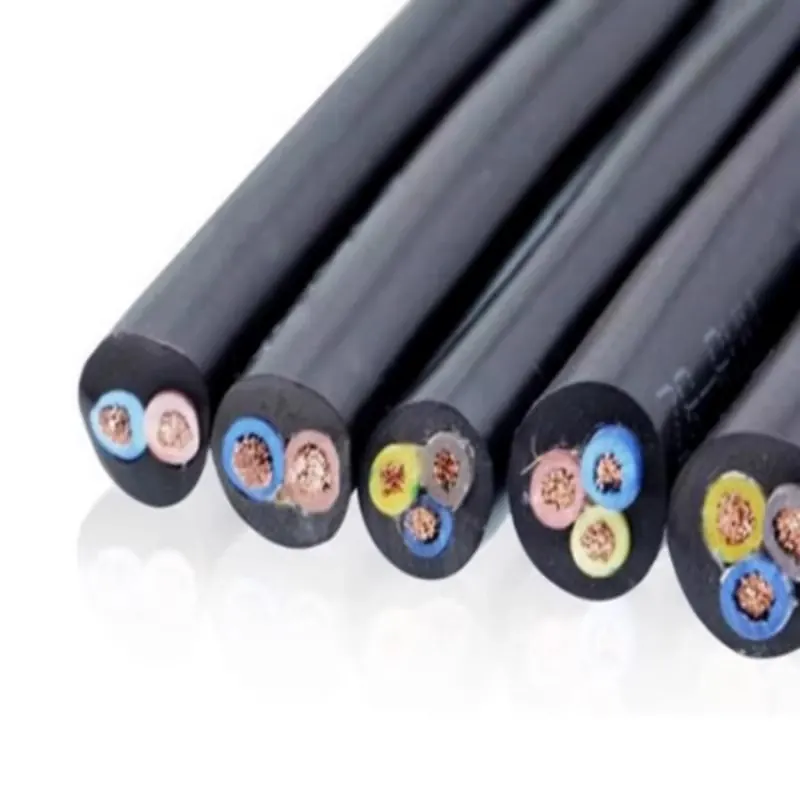
Continuous miners, shuttle cars, cranes and portable tools need cable reeled and dragged daily: fine-stranded conductors with a sheath for abrasion, oil and bending — the duty of YC and YCW rubber cable.
Control and instrumentation cable
Analogue signals in a plant full of large drives need screening and separation to survive; see KVV and KVVP control cable.
Fibre for monitoring and communications
Remote links and distributed temperature monitoring run on optical fibre: see ADSS and OPGW aerial fibre and OPLC, OPMC and GDTS composite cable.
§03 — Risk table
Failure modes specific to these industries
| Risk | Typical cause on site | How it is controlled |
|---|---|---|
| Mechanical damage underground | Traffic and excavation over unarmoured, unmarked routes | Armoured build, correct depth, marker tape, route records |
| Smoke and acid gas in confined space | PVC-sheathed cable in roadways, tunnels or modules | Low-smoke specification with test numbers named |
| Sheath attack by hydrocarbons | Sheath compound not chosen for the fluids present | Sheath matched to actual chemical exposure |
| Flexible cable fatigue | Tight bending, reel over-tension, sharp rock | Class 5 or 6 conductors, correct sheave diameters |
| Instrumentation errors | Control cable paralleling large feeders unscreened | Separation, screening, one defined screen earth point |
Flexible cable is a consumable in mining duty. Set inspection intervals and replacement criteria at design stage.
§04 — Questions from site and project engineers
Frequently asked questions
How does mining cable differ from ordinary armoured power cable?
The difference is duty and fire performance, not only construction. Mining routes are temporary, relocated often and shared with mobile plant, so mechanical protection, flexible conductors and re-termination frequency all rise. Underground runs also need flame-retardant and low-smoke behaviour, since ventilation is limited and egress is long.
Why low-smoke rather than standard flame-retardant PVC underground?
Flame retardance limits fire spread along the cable, but the hazard in a roadway or tunnel is loss of visibility and the corrosive effect of acid gas. Confined-space specifications therefore add smoke density under IEC 61034 and acid gas under the IEC 60754 series.
How is fibre used for monitoring rather than communications?
The fibre acts as a distributed sensor: temperature or acoustic signatures along its length are read from backscattered light, giving a continuous profile instead of spot readings. That suits long routes, conveyors and remote pipelines where powered point sensors are impractical.
What is needed to specify an aerial fibre route?
Tower or pole positions and heights, span lengths, the existing earth wire arrangement, and regional wind and ice loading. Span and sag are calculated per route from that data; a catalogue figure cannot substitute.
§05 — Next step
From site conditions to a quotation
An accurate quotation needs system voltages, fault level, route lengths and installation method per section, chemical exposure, the fire-performance tests required by the site specification, and the hazardous-area classification where it applies — installation in classified areas follows the IEC 60079 series. Our testing and certification page lists reports per shipment.
Send the route list and site specification and we will return construction and drum planning: Request a quotation →