
§01 — What the network demands
Route conditions for duct, buried, aerial and premises fibre
A fibre network is planned backwards from the route. The same twelve fibres can travel in a duct under a pavement, be ploughed into soil, hang from a distribution pole, or run along a transmission line at the top of a tower — and each route asks for a different construction. Choosing by fibre count alone is the most common specification error. Mechanical and environmental inputs decide the build: tensile load, crush and impact, water ingress, rodent pressure, temperature range, and on power lines the electric field and lightning.
| Route type | Condition in service | What it fixes in the cable |
|---|---|---|
| Duct and sub-duct | Pulled through installed duct with bends | Loose-tube build with filling, sheath that pulls cleanly |
| Прямая прокладка в земле | Soil, groundwater, crushing load, rodents | Armouring with water blocking |
| Aerial on distribution poles | Self-supporting spans, wind and ice, UV | All-dielectric design sized for the span |
| Aerial on transmission lines | Tower-mounted, electric field, lightning currents | Earth-wire-integrated build matched to the line’s duty |
| Premises and last drop | Tight bends, risers, indoor fire rules | Bend-tolerant fibre, flame-retardant sheath |
| Smart grid routes | Power and communications on the same path | Composite cable carrying fibres beside conductors |
Fibre count is the cheapest thing to add at manufacture and the most expensive to add later. Plan spare capacity in the first build.
§02 — Recommended cable families
Families that match network routes, and why
GYTA, GYTS and GYTA53
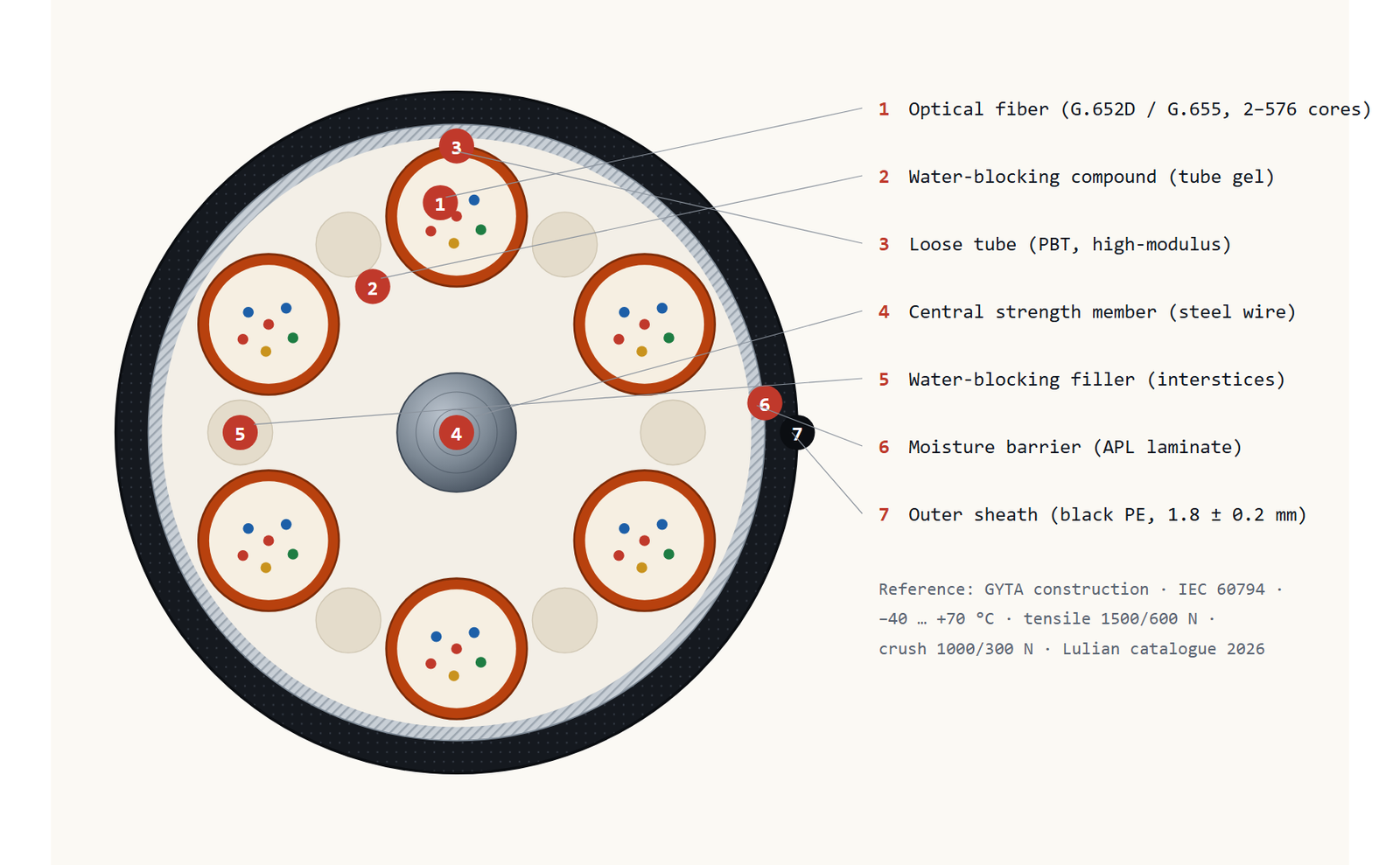
The standard outdoor family: stranded loose tubes with moisture blocking, GYTS adding steel-tape armour and GYTA53 a double armour with a polyethylene sheath for direct burial. See GYTA, GYTS and GYTA53 fibre optic cable.
ADSS and OPGW on power lines
ADSS is all-dielectric and self-supporting, so it can go on an energised line without an electrical rating; OPGW combines fibres with the earth wire and must match its diameter, mass and short-circuit duty. See ADSS and OPGW aerial fibre.
Composite cable for smart grid and last drop
Where communications must reach a point that already has a power connection, composite designs carry fibres alongside the conductors in one cable, saving a second route: OPLC, OPMC and GDTS composite cable.
Fibre categories follow the ITU-T recommendations named in the project specification — G.652D for general single-mode routes, G.657 where tight bends dominate — while constructions and tests follow the IEC 60794 series. Remote cabinets still need an LV supply, sized on the same route data as the LV XLPE power cable feeding them.
§03 — Selection checklist
Decisions that determine whether the route works
| Decision | What has to be settled | Consequence if ignored |
|---|---|---|
| Fibre count and spares | Working fibres plus capacity for growth and re-routing | A second build, or no capacity to restore service after a cut |
| Route and installation method | Duct, burial, aerial or premises, section by section | Armouring chosen for the wrong duty, or wasted cost |
| Water blocking | Filling compound or swelling tape on wet sections | Water tracking along the cable and fibre loss |
| Span and loading for aerial routes | Span, sag, tower data, wind and ice loading | Sag and clearance problems from a table-based choice |
| OPGW electrical duty | Short-circuit and thermal rating of the earth wire position | An earth wire that cannot carry the line’s fault current |
ADSS spans are calculated, not catalogued. Give span, tower data and the wind and ice case; a maximum span without those inputs is not a design.
§04 — Questions from network planners
Frequently asked questions
Which armour do I need for direct burial?
Corrugated steel-tape armoured constructions with an extruded polyethylene sheath are the usual answer, combining crush resistance with protection against rodents and moisture. In duct routes the lighter builds cost less.
Should I use ADSS or OPGW on a transmission line?
OPGW replaces or parallels the earth wire and is chosen when a line is built or rebuilt, since it must satisfy that wire’s electrical and mechanical duty. ADSS hangs alongside the conductors without carrying current, suits existing lines and can often be installed without an outage, but its position must be checked against the electric field at the tower.
How many fibres should be specified?
Count the working fibres, then add spare capacity for growth and for restoration after a cut. Backbone sections carry far more fibres than access sections, and extra fibres cost little compared with a second cable later.
What does a composite cable actually solve?
It removes the second route. Where a low-voltage or medium-voltage connection already reaches a point that also needs communications — a monitored transformer, a metered supply, a remote site — one cable delivers both, with one set of civil works.
§05 — Next step
From route plan to a quotation
A quotation that matches installed cost carries the route plan by installation method, the fibre counts and categories, and for aerial sections the span, tower and loading data. Our testing and certification page describes the reports supplied per shipment.
Send the route plan and we will return construction, drum lengths and hardware recommendations: Request a quotation →