§01 — What the plant demands
Electrical and environmental conditions inside a production facility
A plant network puts several very different duties on the same cable routes: the intake carries the whole site load and must survive the supply authority’s fault level; motor control centres feed loads that start, stop and reverse; automation panels exchange low-voltage signals in the same tray as power circuits; mobile equipment is dragged and reeled. Route conditions add process heat, oil, vibration and dust, and trays where dozens of circuits touch — each pushing the cable away from its catalogue rating.
| Circuit duty | Condition in service | Consequence for the cable |
|---|---|---|
| MV intake and plant substations | 11 kV or 33 kV incomer, high fault level | Size fixed by fault withstand and grouped rating |
| Main LV distribution | 0.6/1 kV, long tray runs, elevated ambient | Ampacity corrected for ambient and grouping |
| Motor feeders and drives | Switching transients, harmonic currents | Screening and symmetrical construction |
| Automation and instrumentation | Analogue and 24 V control beside power cable | Separation plus screening |
| Mobile equipment | Reeling, dragging over edges, oil and impact | Flexible conductors, abrasion-tolerant sheath |
Grouping in a crowded tray is the most common reason a correctly sized cable still runs hot. Count the touching circuits first.
§02 — Recommended cable families
Families that match plant duties, and why
Medium voltage for incomers and substations
Sites taking supply at 11 kV or above distribute it to in-plant substations on XLPE-insulated MV cable with a metallic screen; see the medium and high voltage cable range.
LV XLPE for sub-distribution
XLPE at 0.6/1 kV tolerates a higher conductor temperature than PVC, giving more current from the same cross-section on long tray runs: see LV XLPE power cable.
Armoured cable for trenches and exposed routes
Where mechanical damage is plausible, steel-tape armour carries the duty a tray cannot: see the YJV22 armoured power cable range.
Screened control cable for automation panels
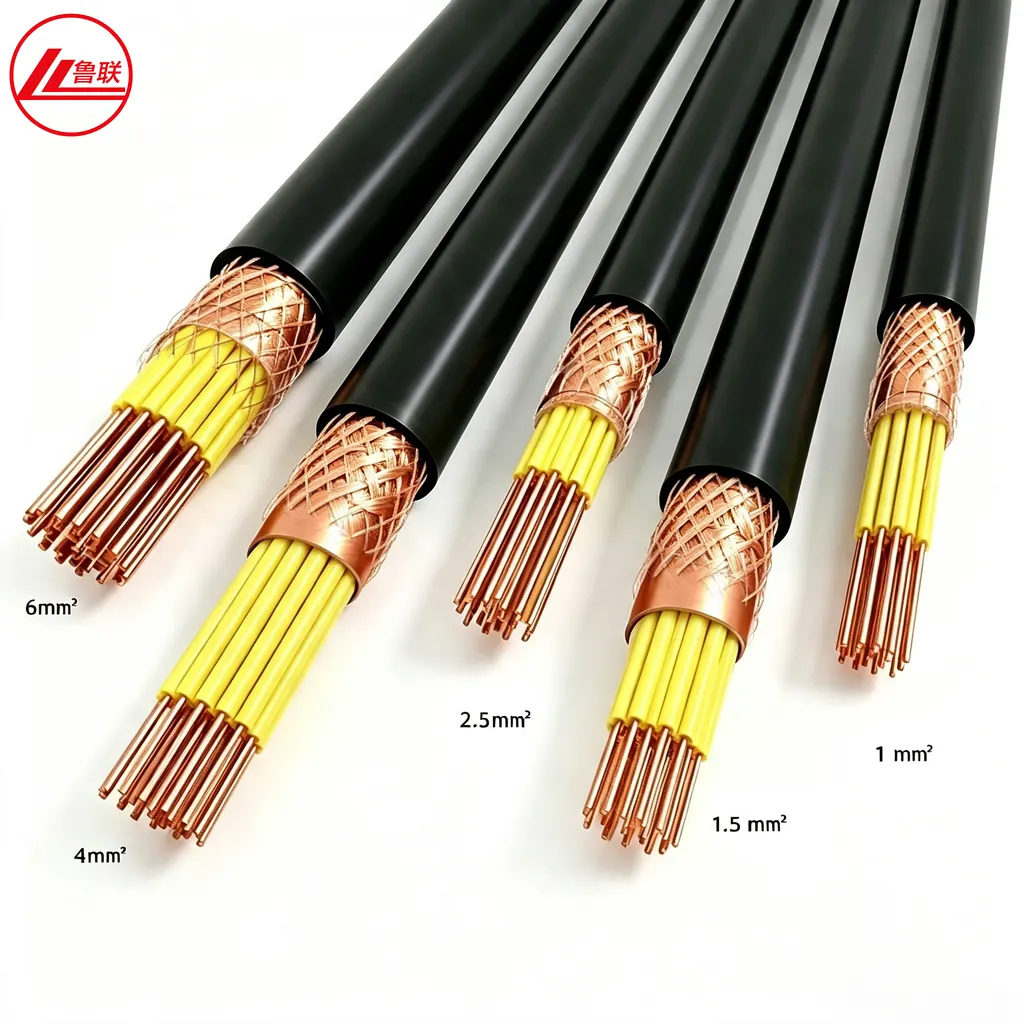
Control cores need a metallic screen tied to panel earth at a defined point so induced voltage never reaches a PLC input: see KVV and KVVP control cable.
Low-smoke halogen-free control cable
In control rooms, enclosed substations and occupied halls, smoke and acid gas matter as much as flame spread — tested by the IEC 60332-3 series, IEC 61034 and IEC 60754: see LSZH control cable.
Rubber cable for mobile equipment
Cranes, hoists, conveyors and portable tools need flexible conductors to IEC 60228 and a sheath that survives reeling, oil and abuse: the role of YC and YCW rubber cable.
§03 — Risk table
Where industrial installations go wrong
| Risk | Typical cause in a plant | How it is avoided |
|---|---|---|
| Signal corruption and spurious trips | Control cable sharing a tray with motor feeders | Separation, screened cores, defined screen earthing |
| Interference from variable-speed drives | Drive output run as ordinary unscreened cable | Symmetrical screened cable with 360° screen termination |
| Excess voltage drop | Feeder sized on current rating alone | Voltage drop checked at route length and load |
| Harmonic heating | Non-linear loads raising neutral and sheath current | Derating or oversized neutral |
| Sheath degradation | Oil or solvent contact with an unsuitable sheath | Sheath compound matched to the fluids present |
Screening only works if it is terminated; a screen left floating performs little better than none.
§04 — Questions from plant engineers
Frequently asked questions
When does a control cable actually need screening?
When analogue signals, encoder feedback or communication buses share a route with power circuits, or when receiving equipment has high input impedance. Short digital runs in clean areas often survive unscreened; anything measuring a value or carrying a bus usually does not. The screen must be bonded at the point defined in the panel design.
What is different about a variable-speed drive output cable?
The drive output carries fast-switching pulses that radiate and reflect along the cable, so the construction is symmetrical with a low-impedance screen bonded at both ends. Termination quality matters as much as the cable, and long motor leads should be checked against the drive manufacturer’s permitted length.
Is LSZH required throughout a plant?
It is normally specified where people work or egress is limited — control rooms, enclosed substations, tunnels, occupied halls — and where smoke would damage product or equipment. Open-air yards often stay with flame-retardant PVC or PE.
Why not use flexible rubber cable everywhere?
Fine-stranded conductors and rubber sheaths are built to move. As fixed wiring they cost more and are harder to terminate. IEC 60228 defines the classes — Class 2 for fixed installation, Classes 5 and 6 where cable is flexed or reeled — and matching class to duty avoids fatigue failures and wasted spend.
§05 — Next step
From single-line diagram to a quotation
An accurate quotation needs the single-line diagram, fault level, route lengths and tray layout, ambient temperatures, the fluids along the route, and the screening philosophy for control circuits. Our testing and certification page covers the reports supplied per order.
Send the diagram and route list and we will return a cable schedule with construction, sizes and quantities: Request a quotation →