§01 — GRID COMMUNICATION
Published 2026-09-02 · Industry analysis
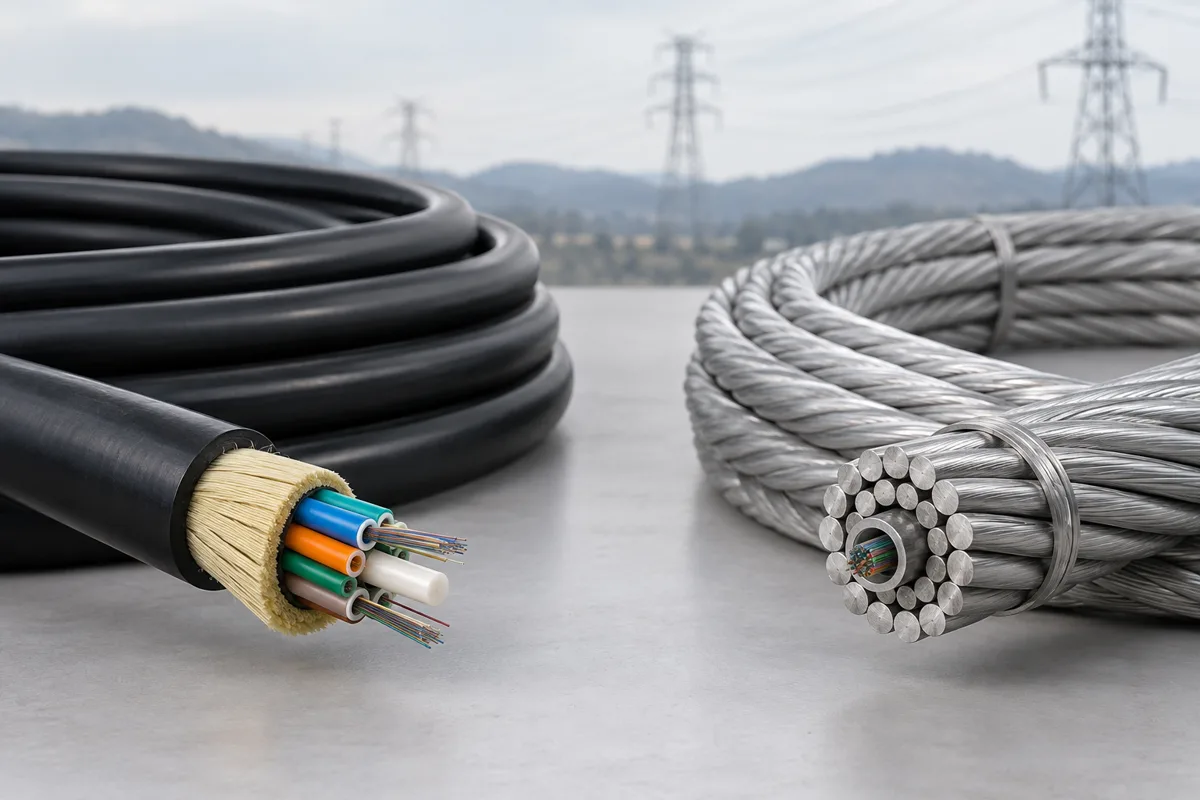
Every transmission and distribution operator needs a communication backbone that follows its own line route: protection signalling, SCADA, teleprotection and metering. Leasing capacity along someone else’s route leaves the utility exposed to third-party outages at exactly the moment it needs the link. Installing fibre on its own towers removes that dependency, and two cable types dominate that work: all-dielectric self-supporting cable (ADSS) and optical fibre composite overhead ground wire (OPGW).
Two different jobs
OPGW replaces the shield wire at the top of the tower, carrying lightning and short-circuit current to earth while the fibre inside it carries the utility’s traffic. Because it performs an electrical function, it is installed when a line is built or when the existing earth wire is due for renewal — both of which require the line to be taken out of service.
ADSS contains no metal. It hangs on the tower below the conductors, at a position chosen so that mechanical clearances and the electrical field are both satisfied. Because it is not bonded into the electrical system, it can be installed on a live line, the main reason utilities buy it for retrofits.
| Design question | ADSS | OPGW |
|---|---|---|
| Position on the tower | Below the conductors, on a calculated attachment point | At the tower top, replacing the earth wire |
| Outage required | No, installable on a live line | Yes, the line must be de-energised |
| Electrical duty | None, fully dielectric | Carries lightning and short-circuit current |
| Sheath choice | Anti-tracking (AT) sheath where space potential is high, PE elsewhere | Aluminium or aluminium-clad steel tube, sized for fault current |
| Typical project type | Retrofit, link extension, distribution voltage lines | New build, earth wire renewal, transmission rebuilds |
| Fibre counts commonly specified | 12 to 144 fibres depending on span and tower load | 12 to 144 fibres, set by tube count and diameter |
Space potential
At the attachment point, ADSS sits in the electric field around the conductors. Where induced space potential exceeds roughly 12 kV, dry-band arcing can track along a damp, dirty sheath; an anti-tracking sheath and a correctly chosen attachment point are the two standard answers.
Span and sag
Span length, wind and ice loading and ground clearance set the sag and tension design, which sets the maximum fibre strain. Preformed tension and suspension fittings and vibration dampers are specified with the cable, not after it.
Fibre count
Utilities rarely size for today’s traffic. Dark fibre costs little at installation, so counts are set by the long-term plan for protection, SCADA and substation data rather than the immediate requirement.
§02 — SPECIFYING THE LINK
What a utility engineer has to decide before the enquiry
The route survey comes first: tower types and residual strength, span lengths, crossing points, line voltage and loading, and the local wind and ice zone. From that the attachment point is calculated for ADSS, or the earth wire is replaced with a matching OPGW whose diameter, mass and fault current rating stay within what the existing towers and fittings can take. The fibre specification — single-mode G.652D or G.655 — follows the distance and equipment being connected.
Both aerial types are covered on the ADSS and OPGW aerial fibre optic cable page. Where a substation drop or a buried section is needed, the duct and armoured constructions on the GYTA, GYTS and GYTA53 fibre optic cable page are the usual choice, and the power circuits feeding the same site are covered in the medium and high voltage cable range.
Span design, attachment point calculation and sheath selection should be confirmed against the line’s survey data and the tower manufacturer’s loading limits.
§03 — FAQ
Questions utilities ask before ordering aerial fibre
Can ADSS be installed without switching the line out?
Yes, and that is its main advantage. Because the cable is all-dielectric and is not bonded to the electrical system, installation crews can work on the structure with the line energised, subject to the utility’s own safety rules.
When is OPGW the better choice?
On new lines and on any project where the existing earth wire is being renewed. The fibre then costs little more than the earth wire replacement, and the cable gains the mechanical and electrical performance of a shield wire.
What does the anti-tracking sheath actually do?
It resists carbonised tracks caused by dry-band arcing on a damp, contaminated sheath in a high electric field. It is specified once the calculated space potential passes the threshold the cable manufacturer states.
How many fibres should be specified?
Enough for protection, SCADA and future substation data over the life of the line. Dark fibre installed now is far cheaper than a second cable strung later.
Does the tower need strengthening?
Sometimes. Every addition changes the loading on the structure and foundations, so the cable’s mass, diameter and tension are checked against the tower’s design limits before installation is approved.