§01 — GRID INVESTMENT
Published 2026-09-23 · Industry analysis
Network spending has shifted away from long-distance transmission and towards the medium voltage layer that actually connects load and generation. Four forces sit behind that shift: cities drawing more power into the same footprint, transport and heating moving from fuel to electricity, renewable and storage projects sitting in connection queues, and assets installed three or four decades ago reaching the end of their design life. Industry reporting over the past few years consistently places distribution reinforcement, rather than new bulk transmission, among the largest blocks of grid expenditure.
For buyers the effect is practical. Programmes are split into many smaller packages, each with a tighter delivery window and each still needing a technically complete specification before an order is placed. A specification that has to be reissued costs more than the cable does.
What each driver does to the specification
| Investment driver | Effect on the MV network | Consequence for the cable specification |
|---|---|---|
| Urban load density | More ring main units, shorter and more heavily loaded feeders | Conductor size set by forecast growth; compact armoured construction for tight ducts |
| Electrification of transport and heat | Sharper evening peaks, frequent thermal cycling | Continuous and cyclic ratings checked separately; conductor material and max operating temperature confirmed |
| Renewable and storage connections | Bidirectional flow, voltage rise at the feeder end | Voltage drop and short-circuit rating verified at the far end, not only at the substation |
| Replacement of ageing assets | Legacy and new cable sharing a route | U0/U class fixed first so joints, terminations and arresters match |
| Undergrounding and shared trenching | Denser duct banks, poorer heat dissipation | Soil thermal resistivity measured; grouping derating applied before sizing |
Three decisions account for most of the rework seen in distribution tenders.
Voltage class
Specify as U0/U — 6.35/11 kV, 12.7/22 kV, 19/33 kV — not as a nominal “11 kV cable”. The U0 value sets insulation thickness and governs behaviour during a single-phase earth fault.
Armouring
Armour follows the installation, not habit. Direct burial and exposed routes need mechanical protection; single-core circuits in trefoil need a non-magnetic armour to avoid induced losses and heating.
Installation conditions
Soil thermal resistivity, depth of laying, duct occupancy and ambient temperature move ampacity more than most buyers expect. Ratings should be calculated from site data, not copied from a catalogue.
§02 — PREPARING THE ENQUIRY
What to settle before you send an enquiry
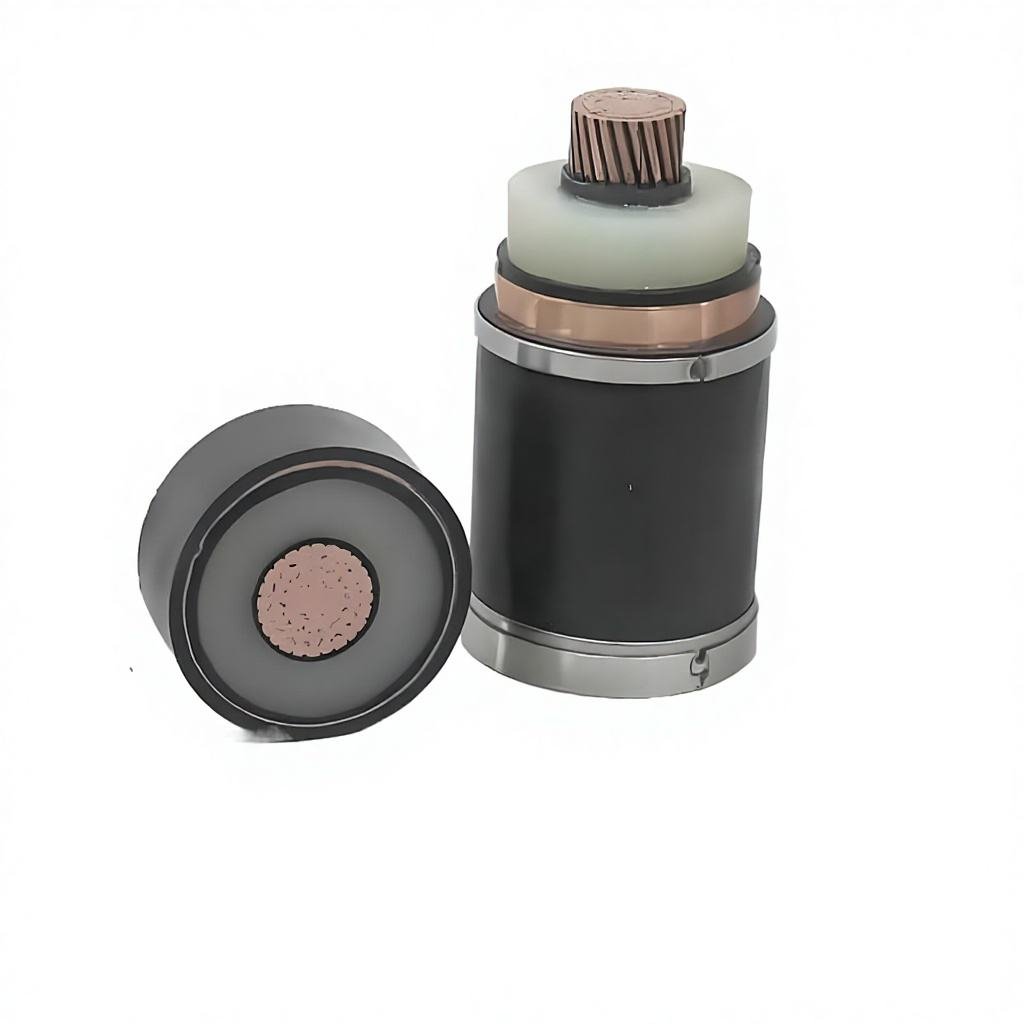
A complete enquiry removes most of the clarification round. Fix the test standard the cable is bought against — IEC 60502-2 for extruded insulation in the 6–35 kV range, or the national equivalent the utility recognises — then the conductor class and material, the screen type and cross-section, the sheath compound and the armouring arrangement.
Where the route crosses roads or railways, or the ground is rocky or chemically aggressive, the outer sheath deserves as much scrutiny as the electrical rating. The medium and high voltage cable range covers the usual distribution classes, with dedicated pages for 11 kV XLPE cable, 10 kV XLPE cable and 33 kV XLPE cable. Armoured constructions for buried routes are described on the YJV22 armoured power cable page, and the information a manufacturer needs to quote accurately is set out in our typical 11 kV distribution project brief.
§03 — FAQ
Common questions from MV cable buyers
Should a new urban feeder be specified at 11 kV or 33 kV?
The upstream transformer and the planned load decide it, not present demand. 11 kV suits dense areas with closely spaced substations; 33 kV becomes the better choice on long feeders and in industrial parks where fewer, larger transformers serve the whole site.
Why does the U0/U notation matter more than the nominal voltage?
U0 is the voltage between conductor and earth or screen, and it drives insulation thickness and the cable’s ability to survive an earth fault of a given duration. Two cables both sold as “11 kV” can have different U0 values and therefore different insulation and fault ratings.
Do I need armour for a ducted installation?
Usually not for protection, because the duct carries the mechanical load; armour is then justified only where the duct route is shallow, shared with other services, or subject to excavation. Direct burial is the case where armour is normally required.
How early should soil thermal resistivity be measured?
Before the conductor size is fixed. A route running through dry sand or made-up ground can force a larger conductor or a bedding of imported fill, and discovering that after the ducts are laid is expensive.
Can one specification cover a whole replacement programme?
Yes, and it is usually worth doing. Standardising the voltage class, conductor material and screen design simplifies jointing, spare holdings and crew training, even when individual route lengths differ.